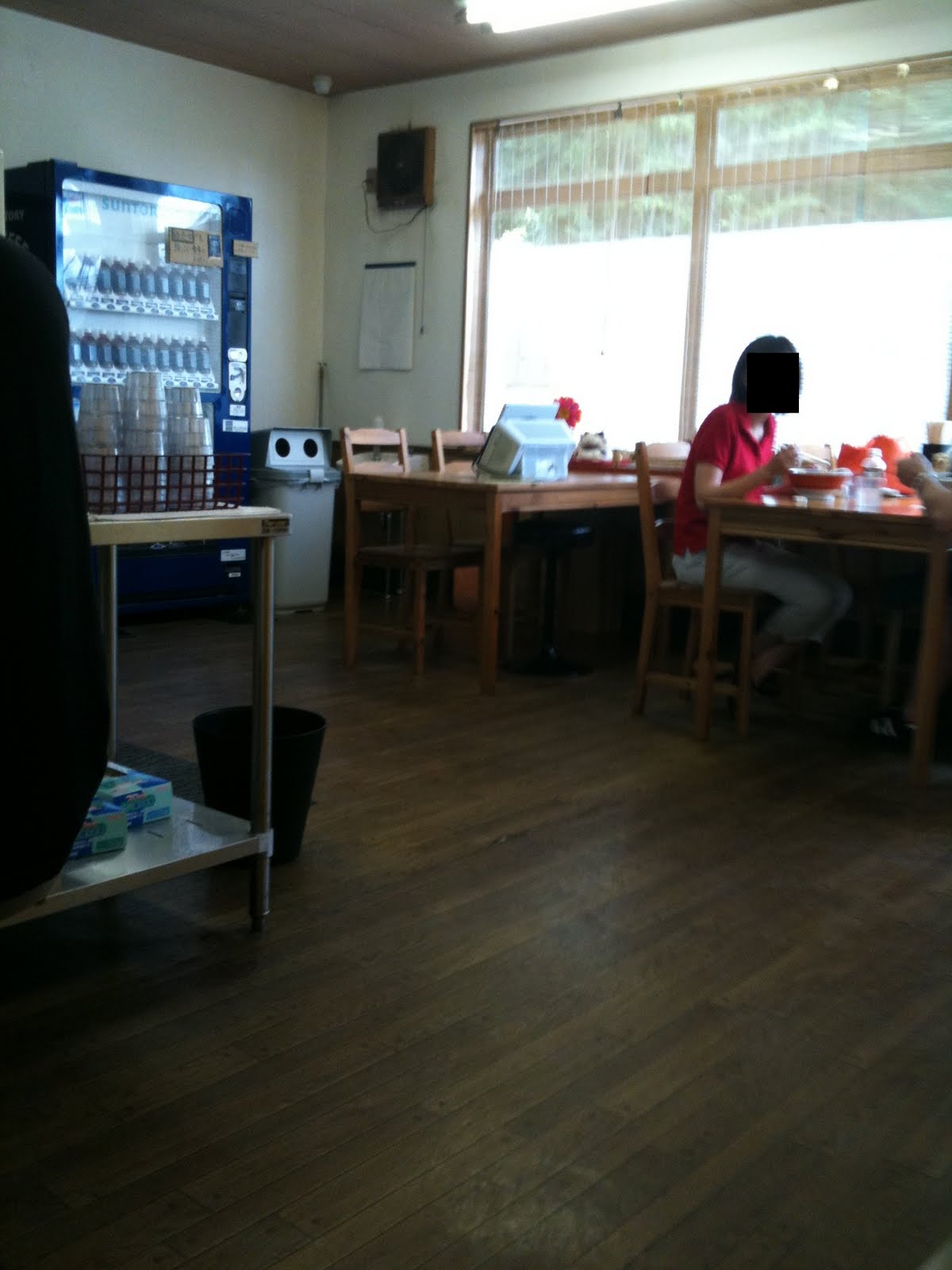
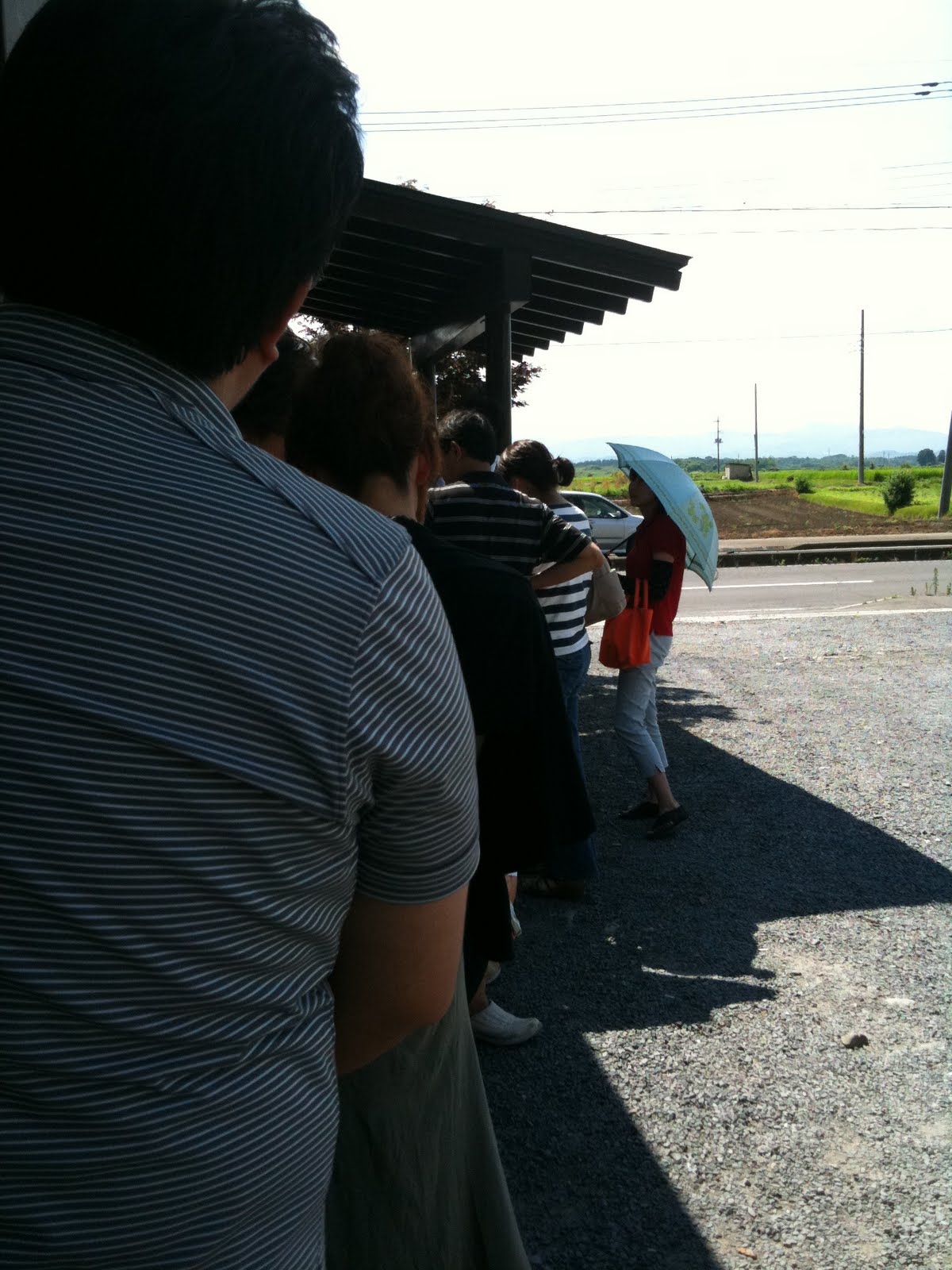
This page is not a review of any single Ramen Jiro branch, but rather an overall beginner's guide to Ramen Jiro for the Tokyo ramen novice.
Last Updated/Refreshed: 2013-12-26
SCROLL TO BOTTOM FOR SHOP LIST IN ENGLISH WITH ADDRESSES AND MAP LINKS

What Is It? (何ですか)
Ramen Jiro is of course technically ramen, but it is somewhat different from any other ramen in Japan. It is tonkotsu broth with shoyu added, but the broth is more like a thinner (but very rich) pork gravy and in most branches it has a large amount of suspended fat (abura). The noodles are (typically) very thick and chewy but not quite as eggy or yellow as regular ramen noodles, and many of the branches make their own, if you see a big green or blue machine that looks like a weaving loom and has flour all over it somewhere in the shop, that's what they make them with. The pork is a very rough cut, usually from the tenderloin but sometimes from some less recognizable part of the pig, and occasionally will be mostly fat. The veggies are usually cabbage or moyashi (bean sprouts), and each branch has its own ratio of the two. Add to this a large amount of chopped garlic (if you want it), usually fresh but not always, and then a few individual stores have optional toppings such as eggs (raw/"nama", 生 or boiled/yude, ゆで), cheese, curry or extra fat from the soup pot, and then curry powder or black pepper on the counter. Many Jiros do not have tissues to wipe your mouth with, or spoons for the broth.
Ramen Jiro is certainly not for those who are health conscious, and those of weaker constitutions can feel a bit queasy after eating there for the first time, especially if they force themselves to finish the whole bowl. The general recommendation that I have heard from Ramen Jiro customers is that on the day you go to Ramen Jiro, you should eat a pear ("nashi" or 梨 in Japanese) for breakfast or lunch that day, and nothing else. If you can't find a pear then perhaps an apple. My personal advice is that you should not force yourself to finish the bowl, this business about ramen shop chefs getting insulted when you leave some soup in your bowl is generally not true, I'm sure they would prefer to get "insulted" by you leaving some in your bowl rather than get insulted by you getting sick all over their shop floor. Also a yogurt drink, available from any conbini, helps soothe the stomach afterwards.
The overall taste is not like any other ramen available in Japan. It's hard to explain on paper or to understand how the flavors all come together without actually tasting it. Ramen Jiro has achieved something of a cult status in Japan, especially among young men - there's only been one or two times out of the 40-50 times I've visited Ramen Jiro branches that there has not been a line of at least 5-10 people (sometimes more than 30) waiting to get in, and 95% of the customers are men (admittedly a non-scientific survey at best). Lines typically start to form 30 minutes or so before each store opens. There is no talking or lingering at Ramen Jiro branches, just eating. Generally I find that a good rule of thumb is that each person on line means on average a 3 minute wait, e.g. 10 people on line in front of you means 30 minutes before you can sit down. Then it may be another 5-10 mins before you actually have a bowl in front of you.
As of this writing (January 2010), there are 33 Jiro branches in Tokyo and the surrounding areas of Yokohama, Chiba, Ibaraki and Tochigi. Most of them are in Tokyo. There are no other Jiro branches in any other regions AFAIK. I have eaten at 32 of them and I plan to finish all of them by early next year. Some of them are in more remote areas of Tokyo (1-1.5 hours from the Yamanote-sen train loop and then some walking) so it's not always easy to get to them, especially when you have a real day job.
I believe Ramen Jiro is more like a franchise than a chain. The original store is the Mita Hon Ten 三田本店, from which almost all of today's Ramen Jiros are descended, typically by a staff member who goes on to start his own shop. I am currently researching the lineage of the different stores and will update this page when I have more info.
Japanese Web Sites (日本語のサイト)
As you can imagine there are many web sites in Japanese devoted to Ramen Jiro. These web sites are sometimes extremely elaborate affairs with charts of the different branches, opening times, reviews and maps and detailed close-up pictures of the ramen. Of these, the following sites are the most useful IMO for understanding the different Jiro branches:
These next three sites provide diagrams and pictures of the geographical distribution of Ramen Jiro branches. The first two use the Google Maps API, while the third one is just a graphic file. However the third one has the advantage of showing you the nearest train lines and stations. These are helpful for when you want to plan a trip to Ramen Jiro in conjunction with some other excursion:
http://www.geocities.jp/erufuxtupo/jiro/ (up to date)
http://www.dd.iij4u.or.jp/~girl2/jiro-map.html (out of date)
Two other good overall sites are here, with addresses and close-up pics:
http://www.geocities.co.jp/Foodpia-Olive/3433/ (up to date)
And this is a listing from Tabelog, a popular Japanese food site, with rankings from the various visitors to the site. "taberu" means "to eat" in Japanese:
http://tabelog.com/rstLst/?SrtT=trend&lid=top_navi1&vs=1&sw=%25E3%2583%25A9%25E3%2583%25BC%25E3%2583%25A1%25E3%2583%25B3%25E4%25BA%258C%25E9%2583%258E&sk=%25E3%2583%25A9%25E3%2583%25BC%25E3%2583%25A1%25E3%2583%25B3%25E4%25BA%258C%25E9%2583%258E&sa=
Obviously all of these sites require some Japanese language reading ability in order to fully understand them. However I linked to them here since you should be able to at least use them to figure out where the Jiro locations are and whether you like how they serve it (based on the pictures). Show the maps to a Japanese friend or the concierge at your hotel and they can help you. A couple of the sites have translation links on them, and you could try
BabelFish or
Google Translate. It's getting better but in general, automated language translation of websites leaves something to be desired.
English Web Sites (英語のサイト)
There are actually a few English web sites that talk about Ramen Jiro. Probably 1/100th the number of Japanese sites though. These sites do not typically analyze it to the degree that the Japanese sites do, however they are still worth a read. This first page below is rather dated, the author stopped updating this site in 2003), there are now (as of July 07) 28 shops. However the way that the author describes the Ramen Jiro taste itself and the etiquette when buying/eating is right on the mark:
http://www.worldramen.net/Tokyo/Jiro@Honten.html (dead but I have left it here in memory)
This next page is an audio report on NPR by Andy Raskin. I think he kind of overplays the Ramen Jiro "mystique" here just a bit, and he makes it seem like there's only one Ramen Jiro shop, but again he describes the actual product reasonably well:
http://www.npr.org/templates/story/story.php?storyId=1604880
And here are two more that accurately describe the physical and culinary experience of Ramen Jiro:
http://benetnate.blogspot.com/2007/06/best-bowl-of-noodles-in-world.html
There's also a moderately well-done YouTube video here:
http://www.youtube.com/watch?v=iApq0GSLCG4&eurl=http%3A%2F%2Fdabble%2Ecom%2Fnode%2F11761217 (this link is dead and I am looking for the video someplace else, meanwhile try
this one.
The general dialogue/plot in this YouTube video is:
- ramen is the national food
- focusing on the HibariGaoka shop, customers lining up outside
- the procedure whereby you tell the Ramen Jiro staff what toppings you want - in this case the customer ordered karame ninniku mashi mashi) - spicyness added to the broth plus an extra extra helping of garlic
- Yoshida-san, proprietor of the HibariGaoka shop, learned the Ramen Jiro technique from Yamada-san, the original Ramen Jiro Mita Hon Ten founder
- demo of how the tonkotsu broth is made by boiling pork, garlic
- chashu, being sliced to go into the bowls
- the process of closing the shop for the night and starting on the next day's broth, the shop hands discussing whether the broth is ready for the customers
- without garlic, there could be no Ramen Jiro and then showing the bowl as it is finalized and presented to the customer
OK, So I Want To Eat At Ramen Jiro, What Do I Do?
ラーメン二郎で食べたいよ!どうすればいい
The first step is to go to Tokyo. I'll assume that you have done that already or are about to. After that, then here's what you do:
Decide Which Ramen Jiro and When
1) Figure out which Ramen Jiro you want to eat at. Use the Otaqe's links above to see which one is near your hotel or wherever it is you are staying. I'll be adding a system soon whereby you can see what ramen shops are in what areas, or are near a given hotel. You can print out the page from the above link and show it to a Japanese friend or to the concierge.
2) My recommendations for the first time Ramen Jiro customer are
Ikebukero and
Shinjuku, these two are more or less on the Yamanote-sen loop line and have other overall positive qualities that make them good choices for first-timers.
3) Figure out when your desired store is open, again using the links above. The grey, blue and orange columns are the days of the week from Monday through Sunday, with the second orange column being national holidays. This symbol 休 means "vacation" or "closed that day". Note that many Ramen Jiro locations are closed at least one day a week, and also many of them are closed for a period in mid-afternoon. Also keep in mind that these Ramen Jiro shops are sometimes informal affairs, meaning they occasionally may open 1/2 hour late, or close 1/2 hour early if they run out of soup or noodles, typically without warning.
4) Make sure that you have 1000 yen notes or plenty of coins for the ticket vending machine, usually the older machines in many of these places do not take larger size notes such as 2000, 5000 or 10000 yen. The guys behind the counter will usually make change if you want but it's best to be prepared.
5) Go there. There are various sites devoted to helping foreigners get around Tokyo, Google for "Tokyo train maps" or "getting around Tokyo" and similar phrases. The
Jorudan English site is good for figuring out what trains go from station A to station B. In conjunction with the Google Maps links that I provide for each Ramen Jiro review, or the Livedoor maps that are on the above Japanese site, you should be able to navigate to the closest train station, then use the maps to get to the Ramen Jiro shop. You should be able to show the maps to any taxi driver once you get out of the station or walk if it's close enough, the majority of them are within 10 mins walk of the station.
Prior to Entering the Store
1) Scope out the line and make a decision as to whether you are going to wait or not. Keep in mind what time the shop closes. Remember some Ramen Jiros may not have restrooms.
2) Many Ramen Jiro branches do not have tissues or napkins. Make sure you have some, such as the small packs that they hand out on the sidewalks in front of train stations. You will go through a few. Try not to blow your nose inside the store if you can help it.
3) Bring a bottle of tea or water, almost all Ramen Jiros have a soft drink dispenser outside. I recommend staying away from carbonated drinks since they will make your stomach feel full faster, and you are going to need every cubic inch of space. While all Ramen Jiros have some sort of water dispenser and cups (typically self-serve), the stores are typically cramped and getting up to refill the small cups 3 or 4 times is a PITA.
4) No smoking in the shops - smoke now if you need to.
Ticket + Ordering Procedure
1) While waiting on line, as you get close to the door, you should be able to see the ticket vending machine. Note where the money goes in, where the tickets and change come out, and what lever you have to hit or knob to turn to make the change come out. In some shops the ticket will be a paper one that prints out, while at others the ticket will be a plastic rectangular chip.
2) Also while waiting on line, you may be asked what size ramen you are going to order via a question "Nani? Nani?" or "Oki-sa wa?" from the guys behind the counter. Or they may make a motion for you to hold up your plastic chip (see next item). This is so that the cook can queue up the right amount of noodles on deck in the pot. This is *not* the time to say what toppings you want, that's later. The answers are either "shou" (small) or "dai" (large). The shou is enough for most people I think (I'm 6' 2" 220 lbs and I can't finish the dai). The dai is sometimes close to a gallon in volume when all of the toppings are factored in. Andy Raskin's link above covers that.
3) It's considered good form to get your ticket from the machine a few minutes before your seat opens up.
Here's a picture of a ticket vending machine from the Omiya shop. The first row has the "small" or "shou" (小) ramen choices. From the left it's shou with just a piece or two of pork, then "shou buta" (more pork), "shou daburu" (double pork, sometimes it's written as "W"). Sometimes the character for pork 豚 will be used. This store also has a "mini" ramen (the green ticket) and tsukemen (the yellow ticket, most Ramen Jiro shops do not have this). The second row has the same things except in "large" or "dai" size (大). Put in the right amount of money, and then the buttons will light up as appropriate. If you see these characters on the button: 売切 or 売り切れ, then that selection is sold out. Press the button and the plastic chip or paper ticket will fall out into a tray on the machine. If you are due change then sometimes you have to turn a knob or press a button (will be labeled おつり) to get it to come out. Take your ticket and get back on line.
4) Most Ramen Jiros do not have tsukemen. Ones that do include Hachioji, Kaminoge, Shinjuku, Sagamihara.
5) Once a free seat opens up go and sit down. There won't be much room. Most Ramen Jiros and most ramen shops in general have a shelf near your legs to put your bag, purse etc. on. You may also find some manga or men's magazines there too.
6) Put your ticket on the elevated counter in front of you. At this time you may be asked what topping(s) you want. The proprietor will say "topping wa?" or "ninniku irimasu ka?". Most shops have the following toppings/flavors/choices:
にんにく ninniku - garlic
野菜 yasai - veggies (beansprouts and cabbage)
脂油 abura - extra fat from the pot
辛め karame - means "spicy" or "with spiciness"
固め katame - means make the noodles "al dente"
You can also say "mashi" or "mashi mashi" to get extra or extra extra of that topping, e.g. "yasai mashi mashi ninniku" = extra extra veggies, regular garlic. OR say "sukuname" (pronounced skoo-nah-may) to get only a little bit. You may also not be asked what toppings until the bowl is ready to be handed to you, if at all.
7) Grab your chopsticks. If spoons are provided, also grab one while waiting.
Eating Procedure
1) OK this is it, it's "go time!" (Remember Lloyd Bridges playing Izzy on Seinfeld?) Once the bowl comes, don't be scared by the initial size. Concentrate. Focus. This is a marathon, not a sprint.
2) You will probably have to take the bowl down from the upper counter and place it in front of you. Be careful - it is full and hot, and probably slippery.
3) Don't put your face directly above the bowl if you can help it - the steam will affect your comfort level and ability to eat.
4) If spoons were provided, before starting to eat, try to ladle some of the broth over the veggies and noodles and pork that were placed on top. This will help bring everything up to an even temperature.
5) Dig in. My recommendation is to start with moyashi and noodles, just to start making progress. Then alternating with pork if you ordered it. I find that saving a couple of pieces of pork for last works well.
6) Some of the pork pieces will sometimes have large sections of fat. I recommend that you do not eat these, and just eat as much meat as you can off the piece. It's OK to leave these fatty bits in your bowl.
7) Due to the fact that it frequently has so much suspended fat, I also leave some of my soup in the bowl, along with any chunks of fat from the pork pieces.
8) If you start to feel full, slow down for a bit, take a breath, drink some liquid. If
Takeru Kobayashi can eat 63 Nathan's hot dogs in 12 minutes, then you can eat one bowl of ramen.
9) BUT DON'T FORCE YOURSELF. Getting sick on the floor of the shop will not enhance the reputation of foreigners in Tokyo in any way, shape or form. I actually know that some Ramen Jiro proprietors will tell customers not to force themselves to finish the bowl if they sense that they are having trouble.
Leaving Procedure
1) These things are more Ramen Jiro etiquette than anything else, it's not like someone is going to chase after you if you don't do this. When you are done, put your bowl and glass on the upper counter. You will usually see a damp washcloth on the counter, take it and wipe down the counter in front of you. Take all of your stuff with you, including anything that you put on the shelf under the counter.
2) The official phrase that you will hear most customers say as they leave is "gochiso sama" or "gochiso sama deshita", meaning "I am a satisfied customer, thank you for the meal". Assuming that you are actually satisfied then if you want to say it then say it, it's part of the custom or ramen shops in general and the customers I've seen seem to do it fairly regularly. If you don't want to then you don't have to.
3) If your stomach is bothering you after leaving the store then get a milk or yogurt at the nearest conbini.
That's it! You've done something in Japan that very few westerners have ever done. I have no statistics to back this up but having done all three and lived here for a while, I would say that far fewer westerners have eaten at Ramen Jiro than have climbed Mt. Fuji, have gone to the top of Tokyo Tower or have ridden a shinkansen...
Where Are Jiro Branches?
ラーメン二郎の支店は どこですか
Click the link under "Shop Address (Japanese)" in the below table, or paste the text into Google Maps, to bring up a Google Map of the location.
| Shop Name (Japanese) | Shop Name (English) | Shop Address (Japanese) | Shop Address (English) |
|---|
| 三田本店 | Mita | 港区 三田 2-16-4 | 2-16-4 Mita, Minato-ku |
| 目黒店 | Meguro Shop | 目黒区 目黒 3-7-2 | 3-7-2 Meguro, Meguro-ku |
| 仙川店 | Sengawa Shop | 調布市 仙川町 1-10-17 | 1-10-17 Chofu Sengawacho |
| 鶴見店 | Tsurumi Shop | 横浜市 鶴見区 岸谷 2-13-7 | Goro Tsurumi-ku, Yokohama 2-13-7 |
| 歌舞伎町店 | Kabukicho Shop | 新宿区 歌舞伎町 1-19-3 | 1-19-3 Kabukicho, Shinjuku-ku |
| 品川店 | Shinagawa Shop | 品川区 北品川 1-18-5 | 1-18-5 Kita-Shinagawa, Shinagawa-ku |
| 新宿小滝橋通り店 | Cascade Bridge, Shinjuku-dori | 新宿区 西新宿 7-5-5 | 7-5-5 Nishi-Shinjuku |
| 環七新代田店 | Ring Daita 7 Shop | 世田谷区 代田 5-29-5 | Shirota 5-29-5, Setagaya-ku |
| 八王子野猿街道店2 | Hachioji Shop Hachioji | 八王子市 堀之内 2-13-16 | 2-13-16 Horinouchi, Hachioji, |
| 池袋東口店 | Ikebukuro East Exit Shop | 豊島区 南池袋 2-27-17 | 2-27-17 Minami-Ikebukuro, Toshima-ku |
| 新小金井街道店 | Shin Koganei Road Shop | 小金井市 貫井北町 3-5-7 | Nukuikita cho 3-5-7, Koganei |
| 亀戸店 | Kameido Shop | 江東区 亀戸 4-35-17 | Kameido Koto 4-35-17 |
| 京急川崎店 | Shop Keikyū Kawasaki | 川崎市 川崎区 本町 2-10 | 2-10 Honcho, Kawasaki-ku |
| 府中店 | Fuchu Shop | 府中市 宮西町 1-15-5 | 1-15-5 Miyanishi-cho, Fuchu - |
| 松戸駅前店 | Matsudo Station Shop | 松戸市 本町 17-21 | 17-21 Honcho, Matsudo City |
| めじろ台法政大学前店 | Mezirodai Shop | 八王子市 寺田町 233-2 | Terada-cho, Hachioji, 233-2 |
| 荻窪店 | Ogikubo Shop | 杉並区 荻窪 4-33-1 | Ogikubo 4-33-1 Suginami-ku |
| 上野毛店 | Kaminoge Shop | 世田谷区 上野毛 1-26-16 | Kaminoge, Setagaya-ku, 1-26-16 |
| 京成大久保店 | Shop 京成大久保 | 船橋市 三山 2-1-11 | Funabashi three mountain 2-1-11 |
| 環七一之江店 | Ichinoe 7 Shop | 江戸川区 一之江 8-3-4 | 8-3-4 Edogawa Itinoe |
| 相模大野店 | Sagamiono Shop | 相模原市 相模大野 6-14-9 | 6-14-9 Sagamihara Sagamioono |
| 横浜関内店 | Yokohama Kannai Shop | 横浜市 中区 長者町 6-94 | 6-94, Naka-ku Yokohama city of millionaires |
| 神田神保町店 | Kanda Jinbo-cho Shop | 千代田区 神田神保町 2-4-11 | 2-4-11 Kanda Jinbo-cho, Chiyoda-ku |
| 小岩店 | Koiwa Shop | 江戸川区 西小岩 3-31-13 | 3-31-13 Edogawa Nishikoiwa |
| ひばりヶ丘駅前店 | Hibarigaoka Ekimae Shop | 西東京市 谷戸町 3-27-24 | 3-27-24 Yato-cho, Nishi-Tokyo City |
| 桜台駅前店 | Sakuradai Ekimae Shop | 練馬区 桜台 1-5-1 | Nerima-ku, 182-8585 Sakuradai |
| 栃木街道店 | Road Shop Tochigi | 下都賀郡 壬生町 本丸 2-15-67 | Mibu castle keep Shimotsuga County 2-15-67 |
| 立川店 | Tachikawa Shop | 立川市 柴崎町 2-10-1 | Tachikawa 2-10-1 |
| 大宮店 | OMIYA | さいたま市 大宮区 下町 1-25 | Omiya Ward, Saitama City downtown 1-25 |
| 千住大橋駅前店 | Senju Station Shop | 足立区 千住橋戸町 10-8 | 千住橋戸 cho, Adachi-ku, 10-8 |
| 茨城守谷店 | Ibaraki Moriya Shop | 守谷市 美園 4-1-5 | 4-1-5 Misono Moriya |
| 湘南藤沢店 | Shonan Fujisawa Shop | 藤沢市 本町 1-10-14 | Fujisawa Honmachi 1-20-14 |
| 西台駅前店 | Nishidai Ekimae Shop | 板橋区 蓮根 3-9-7 | Iidabashi-ku Hasune 3-9-7 |
中山駅前店
新橋店
仙台店
赤羽店
札幌店
 ramen
ramen  in English
  24 by 7